
I Speak the Language. I Still Couldn’t Plan My Own Taiwanese Tea Ceremony.
This reflects one family’s experience — every Taiwanese family is different.
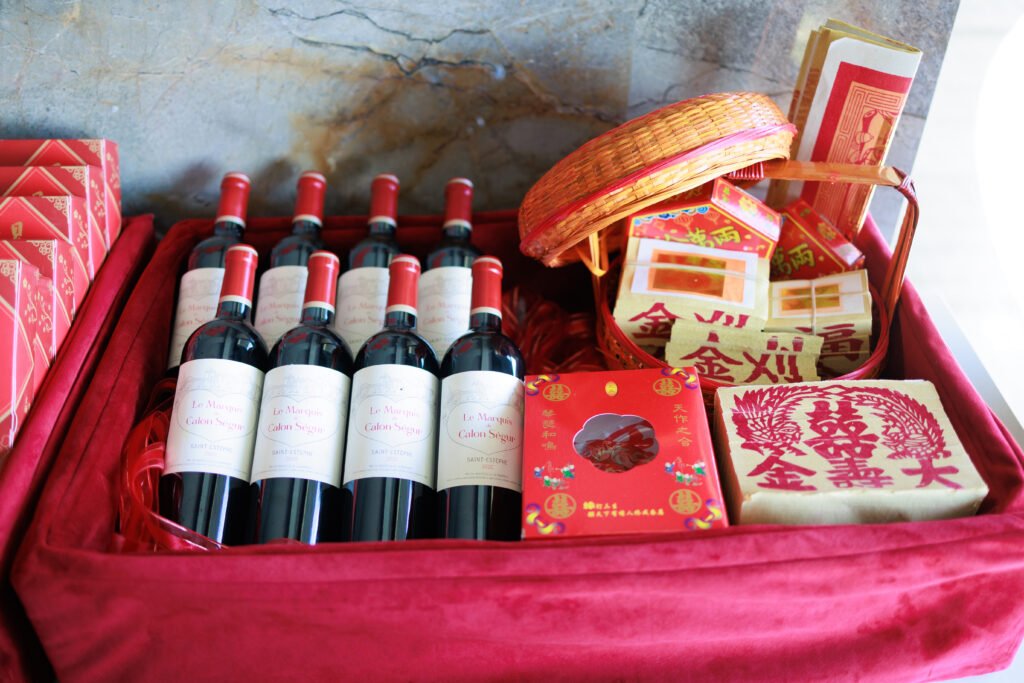
The first real fight of our wedding planning was about twelve objects, and nobody could tell me what they were.
Mom: “The groom’s family needs to prepare the twelve gifts.”
Me: “Which twelve?”
Mom: “His parents should know.”
Me: “They’re Christian. They didn’t go through this.”
Mom: “This isn’t about religion. This is culture.”
So I did what my generation does. I googled it, found a list on a blog, and read it out.
Mom: “That’s not it.”
Me: “Then tell me exactly what you want.”
Mom: “I don’t know. But I know it’s not the twelve you just read.”
That sentence is the whole problem, and if you’re planning a Taiwanese wedding right now you have probably already heard your own version of it.
It was never a language problem
Here’s the part that surprised me: I’m second-generation Taiwanese American. My husband is Taiwanese. We both understand the language and we both speak it. There was no translation gap, no partner sitting confused in the corner of the room.
We still couldn’t get a straight answer.
Because the rules aren’t written down anywhere our parents could point to. They’re held as instinct — absorbed from watching their own weddings, their siblings’ weddings, a grandmother’s corrections thirty years ago. Our mothers couldn’t hand us the list. They could only tell us, immediately and with total confidence, when a list was wrong.
And the twelve gifts were the easy one, because at least they’re a list of objects. The same conversation happened about the colour of my dress, the colour of my shoes, and how much the groom’s family should bring in betrothal gifts. Every time: not that, but I can’t tell you what.
Then it moved on to the things that actually structure the day:
- The order of events. What happens when, and in which house. Get this wrong and nobody in the room knows what they’re watching — including the people being honoured.
- Who sits where. This is the one I’d underestimated. Seating in a tea ceremony isn’t logistics, it’s a statement about standing within a family. There is no arrangement that offends nobody by accident; there’s only the arrangement everyone has agreed to in advance.
None of this got settled in one sitting. It took several rounds of conversation, across weeks.
I grew up in a genuinely harmonious family. We debate, we find the middle ground, we move on — that’s how we work. Wedding planning was the first time in my life I hit a subject where there was no middle ground available, because neither side could articulate the position they were defending.
The part I didn’t expect: two Asian families is harder
I want to say this plainly, because I don’t think anyone says it.
When one side of a couple isn’t Asian, everyone tends to be gracious. The non-Taiwanese family arrives knowing they’re guests in someone else’s tradition. They ask what to do. They follow. Nobody is competing over whose version is right, because only one side has a version.
When both families are Asian, that goes away — because now both sides have a version, and the versions disagree. Nobody is deferring to anybody. My mother wasn’t negotiating with people unfamiliar with the customs; she was negotiating with people who had their own customs, equally certain.
And the religious difference didn’t play out the way you’d assume either. My husband’s family is Christian. When they were handed a list of traditional obligations, they didn’t push back on theological grounds — they went along with it because his non-Christian aunts and uncles had done the same thing at their own weddings. It was family precedent, not a doctrinal decision.
“This isn’t about religion, this is culture.” My mother was, in her way, right about how it would land.
And here’s the part I only appreciated later: the accommodation ran in the other direction too, silently. Our engagement had no 祭祖 (the offering that informs the ancestors). My parents simply left it out, because they knew his family is Christian and that step would have put them somewhere they couldn’t comfortably stand.
Nobody announced this. There was no discussion, no concession granted. The same mother who could not be moved on the twelve gifts quietly removed the one element that would have cost her son-in-law’s family something real.
That’s the thing I’d want you to hear if you’re mid-argument with your own parents right now. The rigidity is usually about the parts they can’t explain. The parts that actually matter to you, they may already be handling without telling you.
What finally worked, and what it cost
We hired professionals for part of it — a Taiwanese wedding service that specialises in the traditional side, and a matchmaker to direct the day itself.
Not everything was bought, though. The 好命婆 (the “good-fortune woman” who leads the bride through the ceremony) wasn’t hired at all. She’s a friend. It’s a role you’re chosen for, not one you apply for, and having someone in it who actually knows you changes the temperature of the whole room.
The damage: roughly US$1,700. That was a package, and I can’t cleanly separate it by event — it covered tea ceremony planning, sourcing and buying the physical items the ceremony requires, and the Chinese wedding ritual on the wedding day itself — the procession that collects the bride.
Our position: we’d book them again. It’s one of the best investments we made on the entire wedding. Not because they knew a secret, but because of what they actually did — which is the useful part, and the part I want you to steal whether or not you hire anyone.
The trick was a draft you’re allowed to argue with
The professional didn’t arrive with the One True Answer. She arrived with her standard version of everything — the list of twelve, the order of events, the seating — and then walked our parents through it, item by item, over several conversations.
And every time my family said “we don’t want this one” or “our family does it differently,” she said the same thing:
“Of course. Every family is different. What matters more is what speaks to your values.”
That’s it. That’s the mechanic.
My mother could never generate any of it from nothing — but she could react to a version of it. Give her a concrete starting point and she could tell you precisely what to keep, what to cut, what her family had always done instead. The draft wasn’t the deliverable. The draft was the conversation starter, and the sentence after it was the permission to change it without anyone losing face.
We had been trying to solve this by searching for the correct answer. There wasn’t one. What we needed was a draft and a neutral voice saying it was fine to redline it — repeatedly, patiently, until both sides had marked up every part of the day.
Once that was running, my husband and I got to do something we’d started to think wasn’t on offer: show up to our own wedding as the bride and groom, rather than as project managers.
Where we broke with tradition on purpose
One thing we changed deliberately.
Traditionally the gold crosses in both directions, each family welcoming the person joining it. The groom’s parents give the bride a gold necklace, earrings, and a pair of bangles — the gesture that receives her into their family. The bride’s family buys the groom a gold necklace. Gold because gold holds value; it’s a blessing and a hedge in the same object.
My husband and I asked for fine jewellery from brands we actually love instead. Our reasoning was simple: pure gold, for us, would go into a safe deposit box and stay there. That felt like a waste of a gift meant to mark something. We’d rather wear the blessing.
Both sets of parents agreed. That surprised me — and it’s the clearest evidence I have for the point above. The tradition wasn’t as rigid as the arguments made it feel. It just needed someone to propose the alternative out loud, with a reason attached.
The moment I wasn’t prepared for
Everything ran smoothly on the day. Genuinely — nothing went sideways, and I credit that entirely to how much preparation went in beforehand. If you want the honest version of that trade: the planning was tedious, occasionally miserable, and involved a lot of conversations about who sits where. The day itself was not.
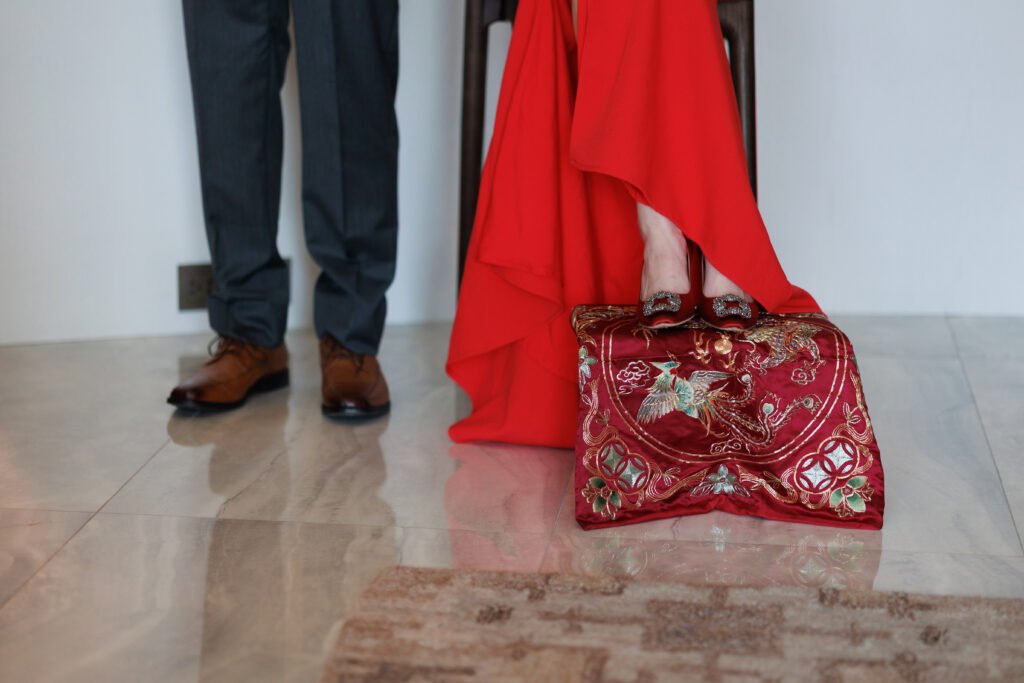
What I hadn’t braced for was 添妝 (the adornment), when my parents dressed me in what they’d prepared.
They had been preparing it since I was small. Some of it since I was born. I was standing there receiving objects that had been set aside for this specific morning, by people who started setting them aside three decades before it arrived.
That’s what made me cry. Not the ceremony. The weight of being handed something that had been waiting for me my whole life.
It reframed the entire year of arguments. My parents had their own tea ceremony, with their own parents’ blessing, and what they were trying to do — clumsily, insistently, without being able to explain any of it — was pass that same blessing forward. They were raised to believe each tradition carries luck, that a missing step could cost their daughter a happy marriage.
I don’t believe that. I think a good marriage is built out of respect, compromise, and finding something interesting in an ordinary Tuesday. I don’t think the twelve gifts have a vote.
But my parents believe it, and they care more about my happiness than anyone alive. If they think a proper tea ceremony is part of the path there, I’ll walk it. That’s not a concession. That’s just what it looks like to love people who love you in their own vocabulary.
What we made
The thing I wish we’d had at the start wasn’t a rulebook. It was a document to argue with.
So we built the piece we could actually put in someone’s hands: an editable bilingual program for the tea ceremony — English and 繁體中文 (Traditional Chinese) side by side, four pages, covering the day from welcoming the groom’s family through the closing photos. It comes as a Canva template you edit in your browser, plus a finished sample so you can see what you’re getting.
The Chinese isn’t machine-translated. It follows how a Taiwanese family and the planners we worked with actually name each part of the day — so the elders read it and nod, and your English-speaking guests follow along in parallel. Everyone in the room knows what’s happening and why, which is the entire job.
To be straight about what it is and isn’t: this handles the day itself — so the room can follow what’s happening. It does not settle the negotiation that comes first: the twelve gifts, the order of events, the seating. That took us a professional, several rounds of conversation, and roughly US$1,700. I’d rather tell you that than sell you something that doesn’t do it.
Disclosure: this is our own product, sold in our Etsy shop. Not an affiliate link, no commission from anyone else — you’re buying directly from us.
→ Bilingual Tea Ceremony Program Kit — on Etsy
The other half — The Complete Tea Ceremony Kit — we’re building now. The full bilingual ceremony script, the blessings the elders actually say in Chinese, a personnel checklist, and the seating logic. If that’s the part you need:
→ DM us @thegoodlifemath on Instagram with the word KIT and we’ll tell you the moment it’s ready.
More of the Taiwan we actually live in: the rest of our Taiwan writing.
One last thing
If you’re deep in this right now, arguing with someone you love about objects neither of you can name: it isn’t really about the objects. It’s about whether the blessing gets passed on properly, and everyone involved is trying to make sure it does.
You don’t need the correct list. You need a list, and permission to change it.
I know this web site offers quality dependent articles and
additional stuff, is there any other web site which presents these kinds of things in quality?
Thanks for the comment! I’m super happy that you found the articles useful. I’m sure there’s lots of other websites that present quality content as well.